Showing posts with label fig. Show all posts

Monday, September 21, 2009

Sexy fruit: figs

Don't you think figs are the sexiest fruit out there? I love figs and it's a treat when they are finally in season. I recently bought a fig tree for my apartment. I might be over-confident in thinking I can grow a healthy fig tree in a Manhattan apartment, but it's worth a try, no?

Figs are here and will be gone soon. While they're around, I'm taking advantage. I recently made a batch of David Lebovitz's fig ice cream. David is the master of frozen desserts so I figured I couldn't go wrong with his fig ice cream recipe. The ice cream has a lovely fig flavor and a deep purple color. It such an unusual flavor for ice cream that it is worth the effort to make a fresh batch while figs are in season.

For other fig dessert ideas, see my friend Jennifer Davick's recipe for Fresh Fig Frozen Yogurt here on her blog, and her feature on Design*Sponge with a recipe for
Fresh Mini Fig Pies with Honey Mascarpone Cream, here.


Fig ice cream (from Perfect Scoop: Ice Creams, Sorbets, Granitas, and Sweet Accompaniments by David Lebovitz)

2 pounds fresh figs
1/2 cup water
1 lemon
3/4 cup sugar
1 cup heavy cream
1/2 tsp freshly squeezed lemon juice or more to taste

Remove the hard stem ends from the figs, then cut each fig into 8 pieces. Place the figs and water in a medium saucepan. Zest the lemon directly into the pan. Cover and cook over medium heat, stirring occasionally until the figs are tender (8 to 10 minutes).

Remove the lid, add the sugar, and continue to cook, stirring frequently, until the figs reach a jam-like consistency. Remove from heat and cool to room temperature. Once cool, puree figs in a blender with the cream and lemon juice (puree quickly so as not to whip the cream). Taste and add more lemon juice as desired.

Chill thoroughly, then freeze the mixture in an ice cream maker according to manufacturer's directions.


Wednesday, October 03, 2007

Mascarpone cheesecake (with rose-scented geranium water)

I’ve been looking back at recent posts and realize my blogging is skewing toward sweets. I think that’s due to a few factors: 1) I enjoy baking tremendously. I appreciate the combination of precision required to get the chemistry of baking right with the left-brain creativity associated with decorating and presenting baked goods; 2) baked goods are more fun (and easy) to share and therefore even more satisfying than cooking for two; and 3) they are easier to blog for a very practical reason which is that photographing a creation in natural light (a must) is much more difficult with a savory dish than a baked good. It requires either making something well ahead of dinner, or saving a portion to photograph the next day (and hoping that the refrigerator and time do not ruin the beauty of the just-cooked food). That said, I think I need to head back toward sweet and savory balance. That is, after this week’s post which I cannot resist. I’ve noticed others participating in the “weekend herb blogging” event for some time. It’s a food blogging event hosted by a different blogger each weekend and involves submitting a dish cooked with an herb or plant to the host blogger (this week's event hosted by Cook (Almost) Anything at Least Once). I’ve parked the idea of participating in the event somewhere in the recesses of my mind and the idea rose (no pun intended) to the fore when I was introduced to a sumptuous mascarpone cheesecake recipe which contains rose water made from rose-scented geraniums. I had the cake on our trip down south and managed to wrangle the recipe out of the pastry chef.

Needless to say, there were many challenges in making the dish, not the least of which was locating rose-scented geraniums (and organic plants at that!) and making rose water. Apparently, rose-scented geraniums are simply not available in New York City (at least not in the fall). I was determined to get my hands on the plant vs. substituting with commercial rose water since the taste of the rose-scented geranium water was one of the main things that drew me to the dish. Commercial rose waters always strike me as overly floral and somewhat soap-like in flavor and, are, in my humble opinion, to be avoided at all costs. Unlike the former, fresh syrup made with rose-scented geranium leaves has a subtle, slightly intoxicating rose scent unlike any typical rose you have ever smelled. It lent a wonderful, sophisticated and unexpected flavor to the mascarpone cheesecake, which frankly would have been excellent with out it, but was special with it. I liked the idea of concocting a secret ingredient for the dish, and although highly inconvenienced by, what soon became an obsessive quest to track down rose geranium plants, I was nevertheless energized about my hunt and eager to learn more about this plant that I had never before heard of. After an aborted order with a rather rude vendor out of state, I finally found a nursery that not only had plants in stock but also carried numerous varieties of the plant. They were somewhat taken aback by my ignorance about all things rose geranium but worked with me to identify three different varieties of rose-scented geranium that might work well in a recipe. The plants that arrived were very small and planted in seedling pots but they had generously large leaves, each with its own take on a heavenly rose scent. I decided to mix leaves from the three varieties to make the syrup, which basically involved making a tea from the leaves, straining the liquid, and bringing it to a boil with sugar.

It turns out, rose-scented geraniums are not technically geraniums but rather members of the species Pelargonium. Pelargonium and geraniums are members of the same botanical family. There are over 230 varieties of scented "geraniums" with different leaves, sizes, flower colors and scents (or lack of scent) including rose, lemon, lime, apple, mint and ginger. These leaves are used not only in the kitchen to make syrup for flavoring baked goods (apparently rose syrup and pound cake are a classic), jellies (rose traditionally a flavor in apple jelly), and flavored sugar (by storing leaves in a sugar bowl), but also are used out of the kitchen to make perfume. It is the leaves, not the petals, that are scented, and they so fragrant that significantly fewer scented geranium leaves, for example, are required to add rose scent than rose petals would be. For more information, see additional information from the Herb Society of America.

Back to my cake, I made the recipe in stages over a couple of days so as not to become overwhelmed. I made the ginger snap crust (the dough of which would make a wonderful cookie) and the rose syrup one day, and the filling the next. There are some subtleties in the recipe that I definitely did not execute as well as the restaurant in which I had it: namely tempering the egg and sugar mixture into the mascarpone cheese – which initially resulted in a very lumpy mixture that I had to work hard to smooth out, and adding gelatin to sufficiently thicken the filling (I translated required sheets into powder which is all I had on hand and the final result was somewhat less firm than I would have liked – I’ll have to go back and try that again). But, the bottom line is that the cake came out rich and airy and had wonderful flavor due to the rose water and ginger snap crust. It’s a pretty little dish with figs that dress up the otherwise snow-white cake and it provided a Proustian remembrance of our trip.


P.s. I'm not going to post this recipe broadly as it might not be fair, but if you are interested, please let me know via email.

Thursday, August 03, 2006

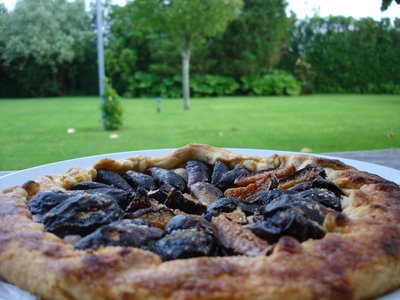
Rustic fig tart


I've been taking a pastry class at the Institute of Culinary Education which has inspired a lot of weekend pastry making. Pastry is the one major hole in my dessert repertoire; I can do cookies, cakes and cupcakes without issue but I've never mastered the art of pastry making so this is my chance. During the first session we learned two basic doughs which offer endless possibilities: pâte brisée, (a flaky dough), and pâte sucrée, a sweet and slightly dense pastry dough. The former is a little tricky for a few reasons: 1) it requires quick work to keep the dough from becoming warm, melting the butter and losing its eventual flakiness 2) it needs to be kneeded without overworking it lest it become tough and 3) it can’t be patched well and needs to be rolled out only once.

There is so much gorgeous fruit in farmers markets now I was inspired to try a fig tart with beautiful fresh figs. I used my class dough recipe and some simple instructions for making a fig tart adapted from one of my favorite seasonal cookbooks.

For the dough (makes 1 1-crust pie)

1 ¼ cups (about 5 ½ ounces) all-purpose unbleached flour
¼ teaspoon salt
1/8 teaspoon baking powder
8 tablespoons (1 stick) cold unsalted butter
2 to 3 tablespoons cold water (put ice cubes in glass of cold water to chill)

For the filling

6 tablespoons sugar or less if fruit is quite ripe
1/5 lbs fresh figs

To make the dough

Combine flour, salt and baking powder in a medium mixing bowl and whisk to mix. Pour mixture onto a clean, smooth surface such as a stainless steel table. Cut butter into tablespoon-sized pieces and add to dry ingredients. Toss once or twice to coat pieces of butter. Use your hands to rub the butter into the dry ingredients by breaking it into tiny pieces, continuously pinching and squeezing it into the dry ingredients. Be careful to keep the mixture uniform by occasionally reaching down to the bottom of the mixture and mixing all the ingredients evenly together. Continue rubbing the butter into the dry ingredients until the pieces of butter are dime/nickel-sized. Create a well in the center of the dough, spoon 2 tablespoons of the water into the hole, and mix gently with your fingertips, gradually working the water into the dry ingredients. The mixture will crumbly in the beginning but should begin to come together into a ball. If the mixture still appears crumbly after working it, add the remaining water (plus more if needed after mixing together), 1 teaspoon at a time, until the dough holds together easily. (Note: too little water makes a flaky crust that will crack during rolling; too much water makes an elastic, bread-like crust that lacks flakiness. Do not over-work the dough or it will become tough.) When finished, you should have a ball of dough with small pieces of butter still visible in the mixture. Wrap dough in plastic wrap and press it into a 6 inch disk. Refrigerate until firm, or until you are ready to use it, at least 1 hour.

To make the tart

Clean and dry work surface. Dust lightly with flour. Wipe rolling pin clean. Dust lightly with flour. Pound dough with rolling pin in two directions so it begins to spread out then roll dough into a ~9 inch disk by rolling in one direction (away from you), turning dough 90 degrees and rolling away from you again. Repeat process until you have a 1/8 inch think disc, dusting more flour under dough and on rolling pin if it sticks.

Trace a ~9 inch circle in dough using the bottom of a tart pan as a guide. Quarter figs through the stem or, if large, cut them in sixths. Set aside in a bowl. Just before you are ready to assemble galettes, sprinkle figs with 6 tablespoons of sugar and toss gently to distribute. Transfer dough to a heavy baking sheet. Arrange figs attractively on dough, leaving a 1 ½ inch edge all the way around. Fold the edge over to create a border making sure there are no cracks in the dough or the fruit juices will seep out during baking. Patch, if necessary, with bits of trimmed dough lightly moistened with cold water.

Brush border with a little egg wash (1 yolk lightly beaten with a pinch of salt), then sprinkle the border generously with sugar. Bake at 425 degrees until crust is golden and fruit is bubbly, 22 to 25 minutes. Transfer to a rack and cool slightly before serving.

Variations:
Make several individual tarts instead of one large tart